
Life in Numbers - An Interview with Dr. Jané Kondev
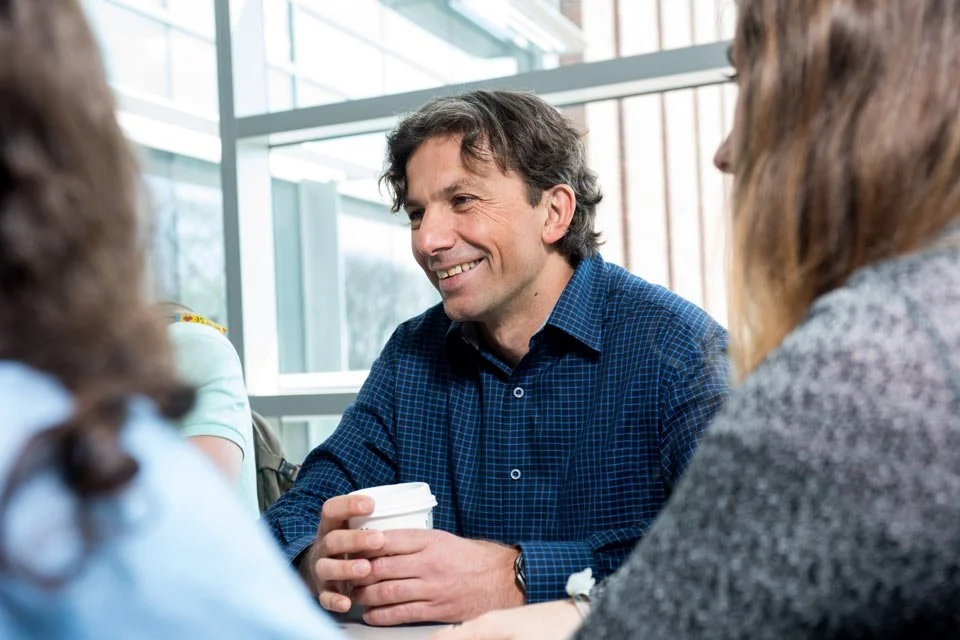
Photo from Brandeis
Dr. Jané Kondev is the William R. Kenan Jr. Professor of Physics at Brandeis University, where he has been a faculty member since 1999. Though originally a theoretical physicist, since coming to Brandeis University, Dr. Kondev's work has shifted to studying at the intersection of physics and biology, employing mathematical modeling and quantitative experimental approaches. His research seeks to explain fundamental biological mechanisms, from gene expression to cellular locomotion. Dr. Kondev is also the co-author of the popular biophysics textbook Physical Biology of the Cell, and served as a Howard Hughes Medical Institute professor from 2014 to 2024.
In our conversation, Dr. Kondev and I delved into physics, biology, and their intersection: biophysics. We discussed how quantitative frameworks can help us understand life, and talked about alien life, how cells move, and the future of biology in the age of artificial intelligence. Dr. Kondev's background in physics brings a fresh perspective to biology, exemplifying the value of interdisciplinary work. I found it fascinating that Dr. Kondev's research grapples with seemingly simple, very fundamental questions that turn out to be quite difficult to answer. Talking with Dr. Kondev reminded me why consistent curiosity is such an essential skill in science, and especially biology—if there's still much to understand about the basic principles of biology, it's important to reevaluate 'higher order' research in the context of our ever-evolving understanding of biology. That involves being adaptive with how we think about biological systems (and supporting this intellectual malleability is one of the founding principles of ENIGMA)!
Vivek: How did your scientific journey begin, and what piqued your interest in theoretical physics and then later, biology and biophysics?
Dr. Kondev: I'm kind of old, so that's a bit of a long story, but I'll try not to make it too long. I got interested in science very early on, and in physics in seventh grade. Partly it had to do with a really good teacher. Another part was that when I was in fifth grade, I was living in New York City (my dad was a diplomat), and then we moved back to what was then Yugoslavia, my country of origin. Because of the way school worked there compared with the US, I was way behind on everything. I was failing all my math courses, for example. But in sixth or seventh grade, they introduced physics as a new course. Since I wasn’t behind on that, I could actually do reasonably well. That’s why I think I got excited about physics: it was the one thing I could do well. I had a good teacher. She was very keen on helping. She saw that I was excited, so she gave me extra problems. I remember working out things like the motion of a spinning top. So I stuck with it.
Where I grew up, there was a real interest in school in physics and math Olympiads. A lot of kids, including myself, would do these competitions. I really enjoyed them, and that maintained my interest, which slowly rolled into my choosing to do an undergraduate degree in physics, then going to grad school, where I really got into research. You asked me about biology and biophysics, but during all that time, I had no exposure to biology. The one biology class I had in high school was terrible, really poorly taught, and I did not like it. I tell this as a joke, but it’s not really a joke: I put it on the same level as my Marxism class, which was taught the same way. The way it was taught was: here’s a book, memorize everything. I didn’t like that. I don’t have a good memory, so I really didn't like biology or chemistry. The only things I liked were physics and math, because I thought they were taught well.
So I went to grad school, stayed with physics, enjoyed research, and then I got very lucky. I got a faculty position at Brandeis University, just outside Boston. It’s a very small research university, probably the smallest research university in the country. By virtue of its size, when I came to campus, I very quickly started meeting people in other sciences. It was easy to make those connections. I met people working on problems in biology and biochemistry. They would tell me what they were working on. That never happened before, because I did my training at large universities like Cornell and Princeton, where I had no opportunities to meet people from biology or other sciences outside physics. I got excited; they were doing really cool things. I realized, through talking to them, that the little bit of physics I knew, I could apply to some of their problems. We started collaborating, and that turned into really fun projects.
Then, a friend of mine you interviewed a couple of months ago, Rob Phillips—he’s also a physicist—was moving to Caltech. We’d been friends at Cornell, and he was looking to start working in biology. He got me excited and sort of roped me into writing a textbook, even though we didn’t know anything about the subject. The idea was: we’ll learn by writing this textbook. So very early on, around 2000, we started writing a textbook on biophysics. Being at Brandeis, writing this textbook, hanging out with Rob—that all got me into this field of biophysics I’m in now.
None of it was planned. There were all these weird, random events that shaped my path in science, and it’s been a lot of fun. That’s the gist of it.
Vivek: Would you say that your approach to biophysics differs from the way you approached physics in the past?
Dr. Kondev: I don’t think so. I think everyone has their own way, and that’s one of the wonderful things about science: it’s very personal.
The popular view is that you learn procedures, you put on your white lab coat, you go into the lab, and follow the scientific method. I don’t think there is such a thing in a rigid sense. Science is about being curious and trying to figure things out, and that’s very personal. Every scientist I know approaches it differently. For me, it’s about breaking things down. We talked about this before the interview. I enjoy breaking things down to their fundamental truth, to the simplest possible thing.
My approach is always: can I understand this well enough that I can explain what I’m doing to a high school student? That was my approach in more traditional physics, very mathematical, more like quantum field theory, and it’s definitely my approach to biological systems. I’m typically interested in things that happen inside cells. Can I look at those phenomena and describe them in very simple terms? Because I’m a physicist, I make those descriptions mathematical. I’m very interested in developing simple mathematical descriptions of various things that happen inside cells. That’s what drives me.
Vivek: What would you say are some of the key principles from physics or math that you’ve found useful in biology? Or is it just that way of thinking?
Dr. Kondev: I really think the main thing physics brings is a way of thinking about problems, any situation where mathematics can be applied. To me, what defines physics is the idea that we can describe nature, and even human or societal phenomena, using mathematics. That kind of confidence, or arrogance, if you will, is the key thing that defines you as a physicist. The specific mathematics or physics principles you end up using or developing are very context-dependent. I can’t say that anything I did as a grad student, or even as a young assistant professor, directly translated into our later work in biophysics. The problems were very different; the mathematics needed was very different. But this belief that nature is understandable in simple mathematical terms is the common thread that connects the work I used to do and the work I do now.
Vivek: That makes sense. I was curious: physics has these big universal laws that govern the natural world. Do you see anything similar in biology? Do you have any mathematical laws?
Dr. Kondev: I don’t think there’s anything yet that I’d point to as being as far-reaching as, say, the law of gravity. Newton described it as a universal law of gravitation—universal in the sense that the same principles that apply to the falling apple apply to the moon going around the Earth, or the Earth going around the sun. That level of universality is mind-boggling: we can use the same principles to describe objects falling on Earth and the motion of planets.
There are universal things in biology, but they’re not necessarily mathematical. They usually come from the fact that all life on this planet has a common ancestor. So if you look at anything alive, especially at the cellular level, you see the same building blocks used over and over again. But in terms of overarching mathematical principles, I don’t think we have them yet. Biology would be incredibly enriched if we did. One of the things animating me, and many of us who came into biology from physics, is the hope that such principles exist, that they’re mathematical, and that maybe we’ll get lucky and help discover them. That’s the hope. I think we’re far from that. I don’t know how far… we're not there yet. Maybe it happens tomorrow, maybe in 100 years, maybe never. I find “never” hard to believe.
Vivek: You think there’s a pretty good chance that there is some way to mathematically, I guess…
Dr. Kondev: Definitely there are specific things. There are gadgets within cells that do different tasks—machines that read DNA and turn it into proteins. They’re fascinating. We can write equations describing how these machines work and predict how they behave in different situations. We can take these machines out of cells, do detailed experiments, test these ideas, and mathematics plays a huge role. All that is happening, but I would say it’s still not at the same level as the universal law of gravitation.
The mathematics we develop for one gadget might work for another gadget. There are some more general principles, for example, Feynman’s ideas about how random Brownian motion can be rectified into useful work inside the cell. Those principles apply to several different molecular “gadgets.” But when you start thinking about cells crawling and doing their own thing, you’re in a different universe of mathematical descriptions. Our mathematical theories of living things are specific to relatively small domains compared to gravity, which reaches over many different scales in the universe. They’re not as expansive, but they’re still useful, exciting, and fun. The hope is that by developing these ideas in many different contexts, we’ll start seeing more general mathematical patterns emerge.
To my taste, I haven’t yet seen something as overarching as gravity or electromagnetism in biology. I’m hopeful we will. One way we’ll know we’re there is if we can think about the likelihood of life on other planets quantitatively. We’re very good now at detecting exoplanets and measuring aspects of their composition. A litmus test for our understanding of living things would be if we could, with some confidence, predict whether a planet, given measured parameters, has life on it or not. We can’t do that now. That tells me we’re not there yet in understanding life as a very general phenomenon.
We haven’t detected life on other planets, but I tend to believe it’s not confined to this planet.
When I was a little younger than you, maybe 13 or 14, another way I got into science was being really into UFOs, aliens, life on other planets, and watching Star Trek. I was totally into all that. I still think one of the great scientific mysteries is: Is there life on other planets? Can we find it? Can we study it? If that happens, I think it will be one of the great revolutions in the history of science, on par with Kepler, Newton, Mendel, Darwin—these big paradigm shifts in our understanding of nature. Finding life on other planets might even eclipse those.
Vivek: Yeah, that would be amazing. But then, how do we find it?
Dr. Kondev: It’s unlikely we’ll send people out there and shake the hands of aliens. We need tools, scientific tools that will allow us, with some certainty, to claim there’s life on another planet by observing it from afar, measuring its composition, knowing something about how it’s evolved. I think I have a bet with Rob about there being, in the next 10 years, an announcement in a major science journal that we’ve discovered life on other planets. I forget how I bet, whether I bet for or against it. It was just for fun. But I’m really hopeful that happens. I’d love to see it. It would be super exciting.
Vivek: On a somewhat similar note, I’d like to talk about your current research at Brandeis. Simply, what questions are inspiring and driving the research that you're pursuing?
Dr. Kondev: I’m really into cells. I like thinking about cells. I think they’re alive; most people think they’re alive. They seem simpler to study than multicellular organisms, dogs, cats, mice, bees, flies, and I’m curious whether there are overarching, general mathematical principles. If we’re going to find them, my bet is we’ll find them by studying cells. I don’t think it matters much which cells.
So I’m excited about understanding how cells do what they do. I try to look at things cells do that are weird from the point of view of physics. There are many things rocks do: they sit, they have a temperature, they might fall apart. Cells share those physical properties, but those aren’t the interesting ones in terms of “aliveness.”
For example, one thing we’ve worked on: there are single-celled organisms that are photosynthetic and swim around. They have two flagella and do a kind of breaststroke. It’s wild. There are no muscles. It’s a single cell. These are protein filaments they use to swim. I got interested in what happens if you cut off one of its “arms,” the flagella. Now it’s missing an arm. It’s kind of like the Monty Python “flesh wound” joke: it’s just a flesh wound for the cell. Because what it does is quickly regrow that arm, and it grows it exactly to the same length it had before you cut it off. This raises a very interesting question: where is the information about the length of this arm encoded in the cell? There’s no simple way to encode this. You could say it’s encoded in DNA, but that makes no sense, because we know DNA encodes proteins. Proteins are like little sticky spheres that diffuse around and sometimes come together to form larger structures. If you’re a little protein, all you know how to do is move randomly (Brownian motion) and stick to other proteins. Those interactions don’t obviously carry information about the length of the flagellum you cut off. I find that bizarre. It’s a very strange behavior of the cell.
If there’s a cup on my desk and I break it, you don’t expect it to reassemble into a cup. It can’t do that. Cells can do that. They’re assemblies of atoms obeying physical law. How does that assembly of atoms know to reconstitute itself this way? We’ve been trying to understand that. We work with experimental groups that do this sort of laser surgery on the arms of these poor cells and watch them regrow. We measure how fast they regrow. We ask: what happens if you chop off both arms? What happens if you keep chopping off the arm—will it keep regrowing? You find all sorts of interesting things that start pointing to a theory, a model of how this works. That’s one of the things we’ve been working on.
Another is memory. One of the main things cells do is make proteins. They have DNA, they read that DNA, they eat, extract energy and materials, and produce proteins, which build structures. The main thing they build is a new cell: from one cell you get two. But you can put a cell in a state where some gene is not being expressed—it’s not making a particular protein—and somehow, as the cell grows and divides over many generations, it retains the memory of that gene being turned off. How does a cell retain memory? It’s a single cell, a bunch of molecules. What is this “memory” really about? It’s not a neural network like in our brains. It’s a collection of molecules that has this property called memory, which my cup doesn’t have. The cup is not living; the cell is living.
We focus on these kinds of weird things cells do that we can measure and manipulate. Then we try to come up with models, usually mathematical equations, often differential equations, that summarize what we know. They’re useful to the extent that we can use them to make predictions for experiments we haven’t done yet. We then do those experiments to see if our understanding is correct, in the sense that our predictions are borne out. We’re also excited when they’re not borne out, because that means there’s something we’re missing. There’s a constant back and forth between theory and experiment. I hope that gives you a sense; we can get into more detail, but I’m not sure how interesting that is.
Vivek: So you’re studying how these bacteria move and what happens when you chop off their flagella…
Dr. Kondev: These particular cells are not bacteria. They’re eukaryotic cells. Bacteria also sometimes have flagella, and they also grow them to a specific length. So they do something similar, but the principles are slightly different. There’s a lot of variation in these single-celled organisms, maybe not surprisingly, because bacteria and eukaryotes, the kinds of cells that make up us and other animals, are quite different. They come from the same ancestor, but we’re quite different from mice, and the common ancestor between humans and mice is actually not that long ago compared to the 4 billion years of life on this planet. Bacteria and eukaryotes split off a few billion years ago, so there’s been a lot of divergence. If you have a common ancestor that lived 4 billion years ago, you’ll look very different and have very different things running your cells.
Vivek: But I’m sure there are process similarities between the mechanism by which bacteria decide the length of their flagella, and how eukaryotes decide the length?
Dr. Kondev: Yeah, maybe. That’s an interesting question.
One of the things is that we have very few well‑studied examples. The flagella cutting-and-regrowth experiments have literally been done on only one kind of cell. There are many different kinds of cells. In bacteria, most of what we know comes from just E. coli, one of many types of bacteria.
Unfortunately, up to now, progress has been slow in the sense that people usually focus on one organism and try to understand how it works. It would be nice to have experiments done on many organisms, because then you can start addressing your question: what are the common denominators? If you’re interested in assembly of structures, what’s common across organisms?
We suspect there will be a lot of similarities, because the “Lego blocks”, the parts used to make flagella in all eukaryotic cells, are the same, as far as we know. In bacteria they’re roughly the same. So we think maybe there’ll be very similar principles. But there’s a lot of work to do. We need experiments on many cell types before we can start seeing truly universal features of this problem. And this is just a simple case: assembling a long whip-like structure. There are many other assemblies in cells.
Then the question is, to what extent do the principles for this thing apply to others? That’s the hard work that remains. People are doing it; it’s ongoing and fun, but there’s a lot to do.
Vivek: What are some other cases where you think similar principles would apply? Because the cell itself—the size of the cell—can vary as well… that doesn’t have to be fixed.
Dr. Kondev: You bring up cell size. That’s actually one of the key things we’ve tried to understand.
For some of these whip-like structures, when they assemble in a cell, if you have a big cell, the structure is big; if you have a small cell, the structure is small. So not only do they assemble to a specific size, but they assemble to roughly match the size of the cell. How that works, we have some ideas, but those are really interesting questions. Many control mechanisms in the cell seem adjusted to the size of the cell.
There’s something going on where the cell is (anthropomorphizing a bit) aware of its size. That’s weird. One example: you might remember from biology class an E. coli cell, kind of like a rod. It grows in length, and then the two halves pinch, and it divides into two cells. You can ask: how does the E. coli cell know where its middle is? The pinching happens because molecular motors accumulate in the middle. But if I’m a single cell full of molecules, how do I know where my middle is? We don’t really understand where this “middle” information is encoded. People find genes where, if you mess with them, the cell doesn’t find its middle. But that doesn’t truly explain things.
It’s like if I remove the steering wheel from a car, you can’t drive it. That doesn’t tell you the principle of how cars work. It only tells you the steering wheel is involved in driving. But what’s really crucial is the engine, which is independent of the steering wheel. So the fact that you can knock out a gene and disrupt division symmetry may or may not be an important clue. This is what gets me excited about cells: questions that a kindergartener might ask after seeing a movie of a cell dividing. “How does that thing know where its middle is?” You know where the middle is because you see the shape and use your brain’s sense of geometry. The cell doesn’t.
We can measure how precisely it finds its middle. If the cell is two microns long, it divides at about one micron, plus or minus five percent. So we know how precise the machinery is, and we can make it less or more precise. We have clues, but no general theory of “middleness” yet. These are questions you can explain to a middle schooler. They’re simple to state, yet they’re the ones we struggle with. Those are the exciting ones.
Vivek: It’s crazy to think about, especially since it seems like such an obvious question.
Dr. Kondev: Yeah. It’s one of those questions where you look at it and think, my cup doesn’t know where its middle is. If I drop this cup, it’ll shatter. If I had a bunch of cups and every time I dropped one it broke exactly in the middle, I’d suspect something special about the middle… maybe it’s been weakened there.
I find it interesting that cells can do these things that are hard to imagine emerging from atoms that have no consciousness, that just fly around, bump into each other, and sometimes form assemblies. How does that give you a gadget that measures the middle, the flagellum length, or how big the cell should be before it divides?
I was just talking this morning with a friend, a biophysicist at the Weizmann Institute in Israel, about his work. He spends a lot of time thinking about: how does a cell know when to divide? He’s made cool progress on that. These are the kinds of questions we’re excited about now. I find them fun because they’re basic.
If I told you I’m trying to understand how gene X‑Y‑alpha‑35 affects the cortex, you might think you need a lot of specialized knowledge to engage. But we’re asking questions that you can explain to a middle schooler, and they make sense of them immediately.
Vivek: I've been thinking about a similar problem. On a larger scale, something we don’t understand biologically about ourselves is consciousness. How can we get an idea of how that works just by studying individual neurons or groups of neurons?
And on the cellular level—we can study the genome, but how can we get any idea of how the system works cohesively and does all this complex action just by looking at individual snippets of genes, or even just the genome?
Dr. Kondev: I suspect you can’t. We have to get away from the genome for these questions. The genome is interesting for many things; it’s not useless. But for these big questions, I think we need to look past it. We have to treat the cell as a control system, described at a higher level.
It’s like physics: when we describe fluid flow, we never talk about individual molecules. We talk about viscosity, density, fluid velocity. These are very useful concepts. We can describe water flow and even build airplanes based on understanding air flow around wings. None of that explicitly invokes molecules, though of course they are there.
One principle from physics I should have mentioned earlier is that to understand what’s going on at the scale of the cell, we should develop new degrees of freedom, new descriptions, that don’t explicitly track genes and molecules. I suspect that’s the way forward, and that principle has served physics well.
If I want to build a bridge and describe the elasticity of beams, I don’t talk about atomic structure and electrons around nuclei. None of that matters at that scale.
Vivek: Do you have any idea how one would even start to move away from the genome and take the cell as a whole system?
Dr. Kondev: You do what we’ve done in physics for centuries: careful, quantitative experiments. For example, on “middleness.” You can do careful experiments with modern tools, imaging individual cells as they divide over many generations. You measure where the division site is. It’s never exactly the middle: if the cell is two microns long, it might divide at 0.9 microns from one end instead of one micron.
There’s variability. You quantify that variability, which tells you something about the underlying mechanism. Then you write down mathematics. My friend Ariel Amir did this and made real progress. You propose mathematical models for how division-site selection might work and see if they reproduce the variability you observe. This is called a phenomenological approach. It’s the approach that’s served physics well. For example, we developed the laws of hydrodynamics long before we knew about atoms.
In biology, the science has developed in a funny order from a physics perspective. We learned about genes and molecules before we studied how collectives behave. Now, in my opinion, people are erroneously trying to jump directly from genes and molecules to whole cells. I think there’s a lot to be done by examining whole-cell behaviors and formulating mathematical laws at that scale—meeting the cells on their own turf, instead of forcing everything down to molecules.
You do careful, quantitative experiments in different conditions, collect data, and then try to build a cohesive, ideally mathematical, picture that explains the data and predicts new phenomena. Then you go look for them. At some point, you’ll connect this back down to genes, which is what makes this even more interesting than many physics problems. We know that on long timescales—evolutionary timescales—tweaks to genes change cells and make them do new things at larger scales.
So there must be some connection between the molecular scale where genes live and the cellular scale a few orders of magnitude up where these phenomena occur. That’s a super exciting challenge. It’s pretty wide open. I think we’re at the beginning of these investigations.
Vivek: As you were saying, it feels like it’d be difficult to move away from that molecular level, because we already know so much about cells structurally. We know organelles that may do certain things, even if we don’t fully understand all of it. To move away from that and look at the cell on a larger scale…
Dr. Kondev: A simple example: you don’t have to know anything about molecular structure to know that in 20–30 minutes one E. coli cell makes two E. coli cells.
Mathematically, that means the population doubles every 30 minutes. You can write a very simple exponential growth law and compute how many bacteria there will be after 10 hours. That law works. You can test it; you see exponential growth. None of that uses detailed information beyond “one cell divides every 30 minutes.”
How that division process works can be very complicated, but you can start from the division time and build a theory on top of that. That’s the kind of thinking physicists bring to life: adjust your models to the observational scale, and inherit from smaller scales just a few effective parameters, like division rate. From that, you derive the exponential curve giving cell number vs time. That’s the thinking I’m betting on.
If you ask every scientist what they’ve bet their career on, they’ll each have their own answer. If you’re doing good science, you don’t really know whether your bet will work out. What you do know is that if many of us make different bets, the field as a whole will progress. Whether my specific bet works out, who knows? I don’t even care that much. I’m happy to try and contribute.
If my bet works out, great; if it doesn’t, that’s fine. I’m confident that if we keep making and testing bets about how nature works, eventually someone hits pay dirt and science moves forward. That’s how it’s worked for a few thousand years, and I suspect it’ll keep working that way.
Vivek: Considering that you’re betting on mathematical principles to look at cells, how do you think that way of looking at cells and biology is changing or being advanced by new computational tools (AI)?
Dr. Kondev: Every new tool in science has the potential to push a field in a new direction. There’s no single magic bullet; you always combine many tools. I think computation, mathematics, and physics are becoming very interesting tools for biology, largely because biology itself has moved in that direction through new technologies.
One well-known example is fluorescent labeling of proteins so they light up under a microscope. You can actually see individual proteins in cells, watch how they move, what they do. That’s relatively new. Once you have that and start tracking motions, you’re making measurements very familiar to physicists: trajectories, diffusion, interactions. All the tools developed in physics for motion, dynamics, interactions suddenly become relevant inside cells.
I think a new generation of biologists will be trained in these tools, because they’re becoming necessary. Through both experimental advances and large-scale computational tools—AI, machine learning—we can now accumulate huge amounts of data very quickly. We have to figure out how to extract real knowledge from all that data. That brings in computer science strongly, and again mathematics underlies much of this.
It’s really fun. Almost anything you might be interested in, physics, math, computer science, finds applications in studying life. Consciousness too: that’s another big one. To me, the two big questions where we’ve not made that much progress, but that are fundamental, are: where do we come from, and what is consciousness? We’ve made huge progress on the “where do we come from” side in cosmology: understanding the universe, its beginning, its evolution over 14 billion years. But “what is life?” and “what is consciousness?”—those go back to the ancient Greeks, and we’re still grappling with them. Maybe foolishly, I think we’re at an interesting inflection point where the “what is life?” part might be coming into focus. I’m not so sure about the consciousness part, but I don’t work on that, so maybe I’m ignorant.
Vivek: We’ve talked about this a lot, but are there any other big questions—or questions you’d be very interested in learning about, even if you're not directly working on them?
Dr. Kondev: Again, this question of “what is life?” I don’t work on it directly, but I’m starting to think about it. Origins of life, how life evolves. We don’t even have a basic understanding of how long it takes life to evolve. If I give you a planet in the universe and tell you its conditions—chemistry, temperature, and how long it’s been around—and ask, “What’s the likelihood life has evolved there?” we really have no way to answer that.
That’s a phenomenal area: origins of life. People are making progress by trying to create lifelike synthetic systems in the lab—taking collections of molecules and coercing them into lifelike behavior, whatever that means. I find that fascinating.
In biophysics, and more broadly, cosmology is also phenomenally interesting and is exploding right now because of ground‑based and satellite‑based observational tools. There’s an enormous amount of data coming in. There’s a lot of work to do. A good piece of advice I once got: if you’re thinking about exciting areas of science, follow the data—areas where new data are being generated because people have developed new tools. That’s where progress tends to be fastest.
Living systems clearly fall into that category. Our tools for interrogating life, from single cells to whole organisms, have become incredibly good and quantitative over the last 30–40 years. Experiments are repeatable; we understand errors and variability. The number of interesting questions is enormous.
When I was studying physics and getting into science, taking classes, reading textbooks, it sometimes felt like everything had been figured out. It can feel like that when you read a polished book. Nothing could be further from the truth. Even the simplest things about living systems we don’t understand, for example, where the middle of a cell is. Anywhere you look, you’ll find interesting questions if you look with that mindset. The most important thing is to retain that sense of wonder you had as a young child. The hope is you still have it after 12 years of school. Sometimes school can unintentionally kill some of that wonder, because it emphasizes reading the book, passing the exam.
There are reasons for that, but the side effect is that the instinct to look at something and say, “That makes no sense,” can get dulled. That’s really the first step in doing science. If you take that approach, there’s an infinite number of things you can work on. You don’t need secret knowledge about “the important problem.” Science works because everyone comes to their own belief about what’s important to work on at a given time. Everyone needs their own agenda.
Vivek: It seems like you’ve certainly retained that sense of wonder. You were saying earlier you weren’t so interested in biology when you were younger.
Dr. Kondev: Not at all. I thought it wasn’t even science. I had zero respect for what people were doing, just because I had no real exposure.
I read some books, which were awful, and had high‑school classes that were even worse. So I had a very skewed, wrong impression of what goes on in biology. I was just ignorant.
Vivek: What do you think is important for cultivating that sense of wonder in students and in oneself? I don’t know if it can be forced, but…
Dr. Kondev: For me, I try to figure things out for myself. Not everything, but if I see a claim in a paper or book, I try to understand it on my own. If I can turn it into a calculation, I’ll sit at my desk and do the calculation. Often there’s no direct reason; it’s not about writing a paper. I’m just curious.
Last summer, for example, I invented a game with big Lego blocks. I made some rules for putting them together and taking them apart, because I thought those rules were similar to some processes in cells. I spent a month with a friend (and a high‑school student helping us) trying to figure out, based on those rules, how big the columns of blocks grow, and so on.
It’s just Lego blocks. It has nothing directly to do with anything. But I thought it was a cool question. I think there’s real joy in figuring things out, whether or not it’s useful. I like reading a lot, science and non‑science, and that fuels curiosity. I’m not very disciplined or organized. For me, it’s random: I’ll pick something up, it grabs me, and I’ll work on it for days or months, for no especially good reason.
Vivek: You said you enjoy reading. This is a question I usually ask people I’ve talked with: if you had to name a book or a couple of books—maybe not scientific at all—that really influenced you, what would they be?
Dr. Kondev: On the science side, when I was in high school, my uncle in the US sent me a book called The First Three Minutes by Steven Weinberg. It made a big impact. He summarized, in an accessible way, our understanding of what happened in the first three minutes after the Big Bang—how elements were created, and so on. That had a big effect on me. Also in high school, Hemingway’s For Whom the Bell Tolls had a huge impact. It’s about the Spanish Civil War. I remember thinking it had this beautiful description of life as a grand adventure. I still think of life and science in those terms.
Later, in my 30s or 40s, I read a book by a French philosopher—a history of philosophy—that had a big impact. It was his attempt to describe philosophical thinking in very simple terms. I’m drawn to books that explain things simply. His thesis was that all philosophy ever developed tries to answer one question: how to live a good life, given that we are finite and will die. I thought that was a clever and interesting way to structure the whole book. He goes through the history of philosophy, from the Stoics to Kant and others, and shows how they grappled with death. I found that super interesting.
When I was in high school, like many people, I also got hold of Feynman’s Lectures on Physics. That really turned me on to physics. It’s a fantastic set of books. Those three or four are probably the ones I still think about, where I took something that still matters to me.
Vivek: What’s your favorite book to read for pleasure?
Dr. Kondev: I don’t reread books; I never read a book more than once. Some people, like Rob, reread some favorites many times. I don’t. So probably my “favorite” for pleasure would be something I read recently. There’s an author, Blake Crouch, who wrote some bizarre science‑fiction books. One of them was turned into a miniseries. It’s about a multiverse where a guy gets lost and keeps meeting versions of himself. I forget the title, but I remember the author.
For fun, I like science fiction where there’s a big idea being explored, not necessarily a lot of action, but a science‑based idea taken a little too far. Maybe it’s not quite right scientifically given what we know, but it could be. That goes back to when I loved reading about UFOs as a kid. I still like mysterious, weird things. But I also like books that talk in interesting ways about the human condition. So it’s pretty eclectic.
Vivek: That’s cool. Lastly, in closing, do you have any advice for young scientists and students like myself in general?
Dr. Kondev: Don’t listen too much to what old guys like me have to say. Follow your own nose and you’ll be fine. I think it’s important to have a sense of adventure. Don’t worry too much about careers and all that. Think about having as many adventures in your life as you can. You can find them in many directions: science is one, traveling is another, reading is another. That spirit of adventure is probably what will get you far, in science or anything else. So follow your nose. And if anyone tells you they’ve figured it all out, don’t trust them. No one has.
I’ve never been good at listening, and it has served me well… which doesn’t necessarily mean it was wise, but there you go. That’s the beauty of life: you don’t know.
I teach first‑year undergrads a lot. When they come to college, many arrive with clearly figured‑out life scripts: they’re going to do this, then this, then this. They usually eventually see how silly that is. Maybe I was a bit like that at their age. But I’m so glad that’s not how things work, because that would make life boring. Who wants to live a script? The whole point is that it’s unscripted. If you keep that sense of adventure in anything you do, especially science, I think it’ll serve you well.
Vivek: Yeah. It definitely feels nice to be free.
Dr. Kondev: Exactly. Freedom is another word for it. Strive for freedom of thought, of action, all of it.
